- care@vastumanojjain.com
- 26 Ram Vihar, Delhi-110092, IN

Why Do We Chant “Om Shanti Shanti Shanti” Three Times? The Spiritual & Scientific Meaning Explained
09
Mar
In Hindu rituals, prayers, and spiritual practices, the chant “Om Shanti Shanti Shanti” is commonly heard at the end of mantras, pujas, and aartis. But have you ever wondered why the word “Shanti” is repeated three times?
This ancient practice is not merely a ritualistic tradition. According to the principles explained in the book Science and Hinduism, the repetition of Shanti (peace) carries deep spiritual, psychological, and cosmic significance.
In Vedic philosophy, peace and harmony are considered the natural state of both nature and human life. Where there is peace, there is happiness. However, even people who appear successful, with wealth, status, fame, and good health, often feel restless or dissatisfied. This is because true peace has two dimensions: internal peace and external peace.
Material success may bring comfort, but it does not always guarantee inner tranquillity. That is why human beings constantly seek peace through spirituality, meditation, astrology, and Vastu Shastra.
The Three Sources That Disturb Human Peace
Ancient Indian sages and rishis deeply studied the causes of human suffering and mental disturbance. They concluded that all problems affecting human peace arise from three major sources.
1. Disturbances from Divine or Natural Forces
The first source comes from unseen cosmic or natural forces beyond human control. These include natural calamities such as earthquakes, storms, floods, hurricanes, and other environmental disturbances.
In Vedic philosophy, these are known as Adhidaivik disturbances, forces connected with divine or cosmic energies.
2. Disturbances from the Physical World
The second source of unrest comes from human interactions and the external environment. Conflicts, unhealthy relationships, accidents, crime, jealousy, anger, greed, and emotional turmoil can disrupt a person’s mental balance.
These are referred to as Adhibhautik disturbances, which arise from the material world and social surroundings.
3. Disturbances from One’s Own Karma
The third and most subtle source is Adhyatmik disturbance, which originates from within. According to Hindu philosophy, a person’s past actions (karma) from previous births may create obstacles, suffering, or emotional unrest in the present life.
This internal karmic imbalance can affect peace, happiness, and spiritual progress.
The Principle of “Trivaram Satyam”
Ancient sages discovered an important spiritual principle called “Trivaram Satyam”, which means:
“That which is sincerely spoken three times becomes powerful and effective.”
Even in modern culture, repeating something three times is often used to emphasize truth or seriousness. For example, in a court of law a witness declares:
“I shall speak the truth, the whole truth, and nothing but the truth.”
Similarly, repetition strengthens intention and focus.
Recognizing this power, Hindu sages incorporated the repetition of Shanti three times in prayers and rituals to remove disturbances from all three sources of suffering.
Why “Shanti” Is Chanted Three Times
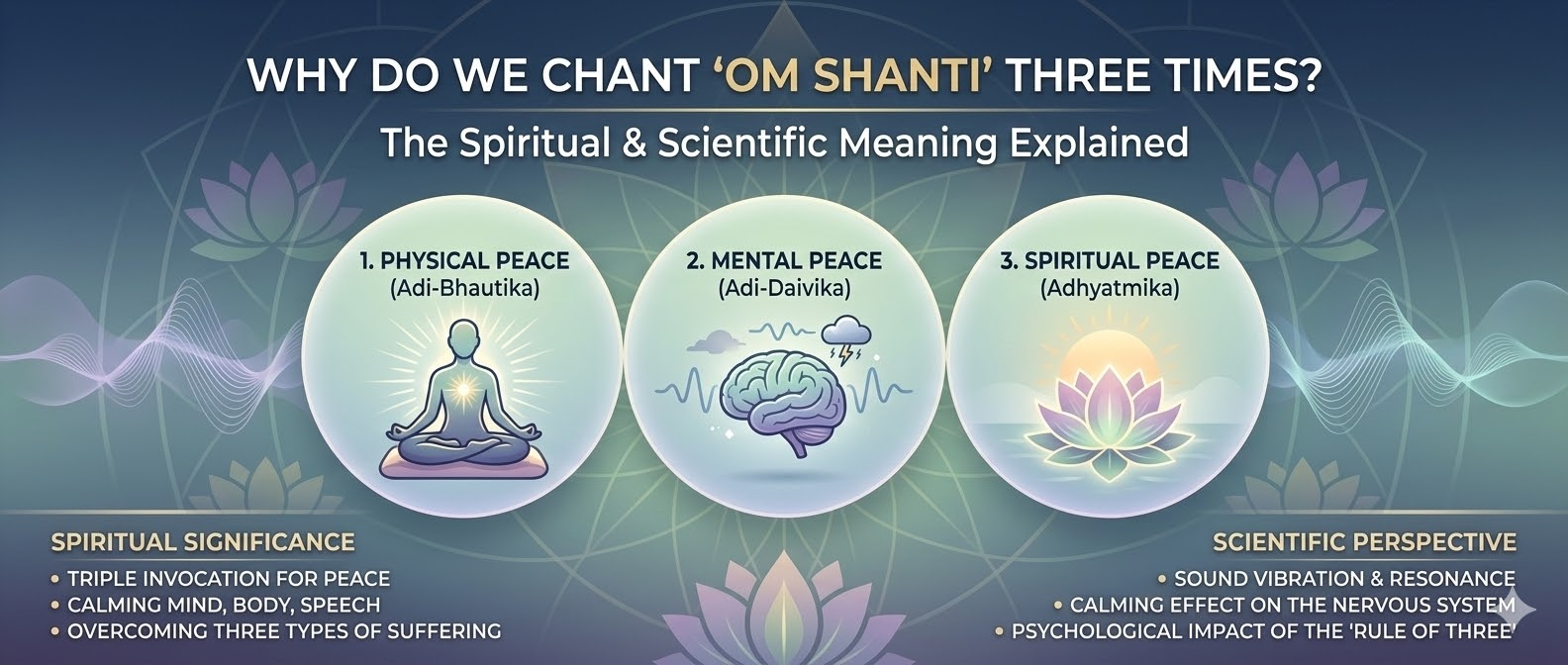
When we chant “Om Shanti Shanti Shanti”, each repetition is directed toward restoring peace in a different realm.
First Shanti – For Universal Peace
The first “Shanti” is spoken aloud and directed toward cosmic or divine forces. It is a prayer to bring harmony in nature and protect humanity from natural disturbances.
Second Shanti – For Peace Around Us
The second “Shanti” is chanted more softly and is directed toward our environment and people around us. It seeks peace in relationships, society, and the physical world.
Third Shanti – For Inner Peace
The third and softest “Shanti” is meant for our inner self. It helps calm the mind, purify karmic influences, and restore spiritual balance.
Spiritual and Scientific Significance of Chanting “Om Shanti Shanti Shanti”
From both spiritual and psychological perspectives, chanting this mantra helps in:
- Reducing mental stress and anxiety
- Creating emotional balance and positivity
- Aligning inner energy with universal harmony
- Promoting mindfulness and meditation
- Enhancing spiritual awareness
The vibration of “Om”, combined with the intention of peace (Shanti), creates a powerful calming effect on the mind and surroundings.
The Vastu and Astrological Perspective
In Vastu Shastra and Vedic Astrology, disturbances in life are often linked to energetic imbalances in our surroundings or planetary influences. Chanting Om Shanti Shanti Shanti helps harmonize these subtle energies and restore balance.
Renowned Vastu expert and astrologer Manoj Jain, founder of vastumanojjain.com, emphasizes the importance of combining ancient spiritual wisdom with practical Vastu principles to create peaceful homes and workplaces.
When the energy of a space is aligned according to Vastu and supported by spiritual practices like chanting, meditation, and rituals, it promotes health, prosperity, and inner peace.
Conclusion
The ancient tradition of chanting “Om Shanti Shanti Shanti” carries profound wisdom. It reminds us that true peace must exist at three levels, cosmic, environmental, and internal.
By chanting “Shanti” three times, we seek harmony from nature, peace in our surroundings, and tranquillity within ourselves.
In today’s fast-paced world, this simple yet powerful mantra continues to guide people toward balance, spiritual awareness, and lasting peace.
For deeper insights into Vastu Shastra, astrology, and the scientific wisdom of Hindu traditions, visit www.vastumanojjain.com and learn from Vastu expert Manoj Jain, who brings ancient knowledge into modern life.